

Key Summary

  • Solar energy helps commercial buildings significantly reduce electricity bills and operational costs.

  • Businesses benefit from government incentives, loan options, tax benefits, and fast ROI.
  • Solar panels enhance property value, brand reputation, and long-term energy independence.

  • Solar adoption supports sustainability goals, reduces carbon emissions, and meets environmental regulations.

Solar energy is rapidly turning out to be an important source of power for commercial properties in India. With rising electricity tariffs, growing demands for electricity, and the growing trend for sustainable business practices, solar energy has attracted the attention of commercial property segment owners. The uses of solar energy for commercial purposes go well beyond saving costs.

Why Solar Panels Are Suitable for Commercial Buildings

The PV cell generates electricity from the photovoltaic effect. When these cells are exposed to sunlight, the electrons get excited, resulting in the generation of an electric current. The generated electricity can be directly utilized for various commercial applications, for charging batteries, or for connecting it to the utility grid, depending on the configuration of the system.

There is substantial power demand from commercial buildings in India, primarily during peak daytime hours. The peak demand pattern in commercial buildings matches the availability of solar power. There is also an increasing power cost for businesses, along with intermittent power supply in some sectors. This has prompted increasing government support for the use of alternative power sources.

Start Saving On Energy Bills Now!

We MANUFACTURE. We INSTALL.
No Middleman. No False Warranties.

Key Benefits of Solar Panels for Commercial Buildings

Solar energy is becoming a smart choice for commercial buildings due to rising electricity costs and sustainability goals. Here are the major benefits:
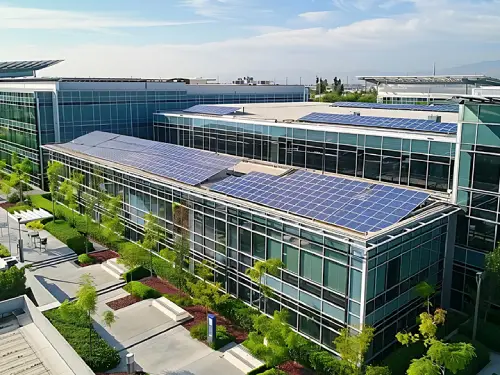

  • Saves a Lot of Money on Electricity Bills: One of the most significant benefits of commercial solar panels is cost savings. Businesses consume high levels of electricity for air conditioning, lighting, production processes, and equipment operation. Installing solar for commercial buildings can substantially reduce monthly power bills. With an on-grid solar system, businesses can maximize solar energy during daytime hours and draw electricity from the grid only when needed.

  • Access to Government Incentives & Attractive Loan Options: The government actively promotes solar adoption through incentives, subsidies (varies by state), and favorable financing options. Businesses can avail collateral-free loans from nationalized banks that can be used for solar installation. Savings generated from lower electricity bills are often sufficient to pay monthly EMIs for these loans. In addition, businesses can benefit from accelerated depreciation and other tax-related advantages, reducing the financial burden further.

  • Increases Property Value: Commercial buildings equipped with solar systems are more attractive to tenants, buyers, and investors. A building with lower energy costs offers a strong advantage in the competitive real estate market. If a business plans to sell the property in the future, installed solar panels can increase market value. Real estate experts agree that properties with energy-efficient solutions are likely to sell faster and at better pricing.

  • Provides Energy Independence: Businesses using on-grid solar systems can generate their own electricity, reducing dependence on power distribution companies. This protects companies from fluctuating electricity prices and supply issues. Since power tariffs rise frequently in many Indian states, solar allows businesses to lock in lower energy costs and avoid unexpected price hikes.

  • Supports a Green and Sustainable Brand Image: Modern consumers prefer eco-conscious brands. Installing solar panels showcases a company’s commitment to sustainability and environmental responsibility. Solar energy reduces carbon emissions, lowers reliance on fossil fuels, and aligns businesses with global sustainability trends. Environmentally responsible companies also attract investors and partners who value renewable energy practices.

  • Reduced Maintenance Costs: Solar panels require very low maintenance. They contain no moving parts, which means minimal wear and tear. Once installed, commercial solar systems can operate effectively for 25–30 years with basic upkeep. Routine maintenance typically involves cleaning panels a few times a year to remove dust and maintain efficiency. On-grid systems do not require batteries, helping companies avoid battery-related replacement and maintenance costs.

  •  Net Metering Enables Extra Earnings: In many cases, commercial solar systems generate more energy than the building consumes. Through net metering, excess electricity can be sent back to the grid. Power distribution companies then credit or pay for the surplus energy generated. This means businesses can not only save money but also earn additional revenue through solar power production.

  • Quick Return on Investment (ROI): Many business owners initially hesitate due to installation costs. However, commercial solar panels offer a relatively fast return on investment. Most businesses recover installation expenses within 5–7 years through a combination of electricity savings and incentives. After the ROI period, the electricity generated becomes completely free, allowing long-term financial gains for decades.

  • Helps Meet Environmental Regulations: Government authorities are implementing stricter environmental norms and sustainability requirements across multiple sectors. Installing solar panels can help businesses comply with green regulations, avoid penalties, and qualify for environmental certifications. Some organizations also receive awards and recognition for adopting renewable energy solutions.

Why Invest in Commercial Solar Panels

Solar panels for commercial use have huge financial advantages for companies. Solar energy lowers electric bills, protects against future increases in electric costs, and ensures a high return on investment. Solar energy also improves the positive impacts of organizations on the environment.

Additional benefits may include lower operational costs, government incentives and tax savings, property value appreciation, and reduced carbon emissions. When businesses look to optimize costs while being environmentally responsible, commercial solar panels prove to be an astute, long-term investment choice.

FREE SOLAR EXPERT CONSULTATION

Conclusion

Solar energy systems have also proven to be a viable, progressive, and thoughtful way for commercial establishments to reduce their energy costs and dependencies, as well as to enhance their brand values by adopting solar energy systems. With the help of solar energy systems, commercial establishments can not only reduce their electricity costs but also increase their brand values by taking the right, initial, and important, yet sustainable, steps towards securing a greener future with solar energy systems. Since Indian government policies have become quite supportive, it is significant to consider renowned solar energy system suppliers, such as Alpex Solar, to shift towards greener, cleaner, and more cost-effective energy sources.


Author : Gaurav Bector

Gaurav Bector, Vice President of the EPC division at Alpex Solar, is an Electrical Engineer with 32+ years of experience in the energy sector. He has led business development in smart energy systems, grid automation, and green solutions with top firms like ABB, Siemens, and Alstom. With global expertise across Europe, South Asia, and the Middle East, Gaurav excels in leadership, operations, sales, engineering, and project management.