Key Summary
One of the rapidly growing sources of renewable energy for powering homes and businesses comes from solar energy. As electricity costs have continued to rise and the public continues to realize the importance of going green, solar panel systems have transcended their uses in industries. Nowadays, solar panel installations not only benefit owners of residential properties but also companies, actively switching to solar energy to reduce costs and environmental impact.
What are Residential Solar Panels?
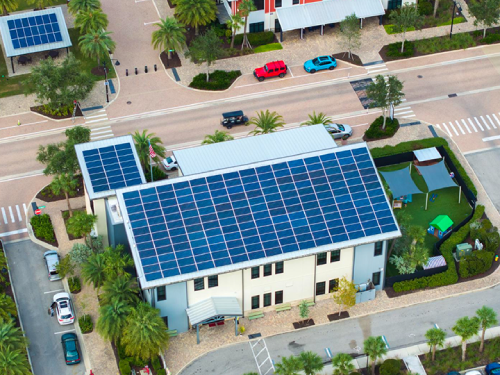
A rooftop solar power system for a residence relies on solar panels mounted atop a residential roof to harness solar power and convert it into environmentally friendly electricity. This will help reduce electricity costs and help mitigate climate change. It comprises a solar panel or array of solar panels made of a semiconductor material called photovoltaic (PV) cells, an inverter, and a mounting framework or stand. These solar power systems can be a grid-connected or off-grid system.
Having solar energy at home provides many financial advantages and independence, as well as environmental advantages. Through solar energy, customers can eliminate their usage fees with the energy company and build a cleaner and more sustainable world for a healthier tomorrow.

What are Commercial Solar Panels?
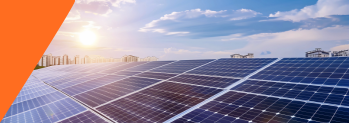
A solar panel that is commercially manufactured is a photovoltaic (PV) component that can change the sun’s rays into useful electricity. The term “photovoltaics” can be defined as the process that converts the sun’s rays into electrical energy. Commercially manufactured PV solar panels comprise several solar cells that contain silicon material, which has positive and negative charges stacked on top of each other in such a way that an electric field is formed. When several commercially manufactured solar panels are combined, they form a solar array that is also known as a “photovoltaic array.” The solar array can be established on land or on top of buildings.
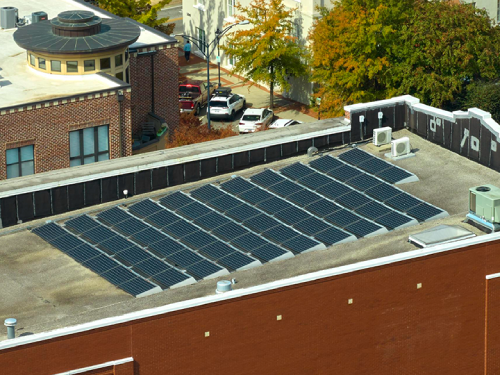
Roof-top-based commercial solar panel plants are in practice in the commercial and industrial segment, as the rooftop generally receives the highest sunlight intensity, which is a prerequisite for the production of renewable power. When functioning, the silicon material in the photovoltaic cells will behave like a semiconductor. When exposed to sunlight, the electrons in the cells gain sufficient energy to move freely, thereby generating an electric current and voltage.
Commercial vs Residential Solar Panels: Key Differences
| Component | Residential Solar | Commercial Solar |
|---|---|---|
| Project Duration | Quicker installation, typically 4 to 12 weeks | Longer timelines, often six months to one year |
| Permitting | Simple permitting process with fewer reviews | More complex permitting with detailed plan reviews |
| Technical Complexity | Less technical and easier to design | More technical with higher electrical requirements |
| Project Costs | Lower upfront project cost | Higher overall project cost |
| Cost Per Watt | Higher due to smaller system size | Lower due to economies of scale |
| Financing | Easier access to loans and financing | Financing options less accessible and less mature |
| System Scale | Smaller system sizes for homes | Larger systems for commercial and industrial buildings |
| Sales Cycle | Shorter sales cycle | Longer and more structured sales cycle |
Cost Comparison between Commercial and Residential Solar Panels
| Category | Residential Solar | Commercial Solar |
|---|---|---|
| Initial Investment | Lower cost due to smaller system size | Higher cost due to larger and more complex installations |
| Typical Cost Range | Affordable for most homeowners | Can range from thousands to over a million depending on scale |
| Payback Period | Approx. 6 to 10 years | Approx. 5 to 13 years depending on project size and efficiency |
| Long-Term Savings | Significant reduction in electricity bills after payback | Large savings on energy bills and potential increase in property value |
| ROI (Return on Investment) | Attractive for personal savings and energy independence | Can exceed 10% and considered a strong financial investment |
| Financing Options | Loans, leases, government incentives, and tax credits | PPAs, loans, corporate financing, and incentives (less accessible) |
| Cost Advantages | Lower entry barrier and quicker payback for homes | Economies of scale reduce cost per watt for large systems |
| Ownership Models | Mostly direct ownership or loan-based | Ownership, leases, or Power Purchase Agreements (PPAs) |
Difference between Maintenance of Commercial and Residential Solar Panels
Residential solar panels are very easy to maintain; they only need occasional cleaning and simple inspections. Basic upkeep can be done by homeowners themselves, or cheap services can be procured whenever necessary. Equipment installed in residential systems is standardized, which renders repairs and maintenance easy and affordable.
Commercial solar panels need more professional, structured maintenance programs. Regular inspections are necessary, as well as scheduled cleaning and performance optimization to keep the energy output high. Advanced monitoring tools can also be used with commercial systems that will quickly detect issues that arise, thus enhancing efficiency. Because of their much greater size and associated complexity, the ongoing maintenance costs for commercial systems are generally higher and tend to call for specialized support.
Which Solar Panel Option is Right for You
Deciding between a solar panel set up for home usage and one that can be used for commercial purposes revolves considerably around the amount of usage and the price one is willing to incur. While a solar panel set up for a residence would work well for a home owner who wants to decrease their electricity bill expenses and attain autonomy over power in a relatively cheap setup in a short period of time, a solar panel set up for commercial use will work well for bigger establishments that consume more electricity. This will provide greater returns over a longer period of time.
Why Choose Professional Solar Panel Solutions
Professional solar panel systems provide the following for residential and business institutions regarding the design, installation, and functioning of the systems by managing key aspects of the process. These key aspects include the sizing of the system, electrical aspects, connection to the main power grid, and monitoring of the installed system.
For residential users, this enables a seamless transition to renewable sources, and it is safe and feasible. For organizations, having professional assistance is crucial because of technical complexities and scaling up. Selecting a reputable organization such as Alpex Solar is very important to have quality design and implementation, as well as improved financial gains.

FREE SOLAR EXPERT CONSULTATION
Conclusion
Residential solar power systems, as well as commercial solar power systems, provide enormous benefits in terms of financial as well as environmental aspects; however, they serve different purposes in terms of meeting their needs related to electricity consumption. Residential solar power systems help people reduce their electricity bills by using solar power, while commercial solar power systems help companies decrease their operational expenditures by using sustainable energy solutions provided by experts such as Alpex Solar.