

Key Summary

  •  Rooftop solar installation is becoming popular in India due to rising electricity costs, environmental awareness, and improved affordability through subsidies and financing options.

  •  A home solar system generates electricity from sunlight and can be configured as on-grid, off-grid, or hybrid to suit household needs and provide both savings and backup power.

  • Before installation, homeowners should evaluate sunlight availability, roof condition, energy consumption, battery requirements, and long-term financial benefits for best results.

  • Choosing a dependable provider like Alpex Solar ensures high-quality panels, efficient installation, post-sales support, and better overall performance for Indian conditions.

India’s residential solar market has emerged as one of the fastest-growing as electricity prices increase and household demand for cleaner energy solutions improves. These come with an added advantage of price benefit through reduced monthly electricity bills with long-term savings in store upon home solar panel installation. Many Indian homeowners are turning to rooftop solar systems as an intelligent investment in energy independence and environmental benefits.

A rooftop solar system captures sunlight from solar panels installed on the roof, converting it into electricity to run one’s appliances. The system can be grid-connected, off-grid with batteries, or hybrid for both backup and cost-saving benefits.

What Is Solar Panel Installation for Home

Home solar system installations refer to the process of installing solar panels on the roof of a home or an open space to supply electricity for domestic use. It enables a homeowner to produce electricity from the sun for self-consumption.

Solar panels work by absorbing light from the sun and converting it into direct current electricity. This electricity is then transmitted to an inverter that transforms it into alternating current electricity that can power household appliances. Any surplus electricity can either be stored or exported to the grid, depending on the configuration.

A normal domestic solar system has the following elements:
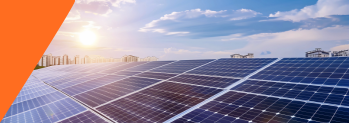
  •  Solar panels to harness sunlight

  • DC to AC Converter or Inverter

  •  Mounting structures for installation

  • Cables and wires for electrical connections

  • Battery (optional) for energy storage

  •  Bidirectional metering for net metering in the case of grid-connected systems

Start Saving On Energy Bills Now!

We MANUFACTURE. We INSTALL.
No Middleman. No False Warranties.

Benefits of Solar Panels for Home Installation

Installing solar panels at home offers strong financial and practical advantages for households.

  • More Affordable Than Before:  Solar has become cheaper due to better technology, higher demand, and government support. EMI and loan options make it easier for homeowners to get started.
  •  Lower Monthly Electricity Bills: Solar power reduces utility bills and protects against rising electricity prices. Net metering lets homeowners export extra power for credits.

  •  Backup Power During Outages: When combined with batteries, solar systems can keep essential appliances running during power cuts and reduce reliance on the grid.

  •  Can Increase Property Value: Homes with solar systems are more appealing to buyers as they offer lower operating costs and modern upgrades, which can improve resale value.

  •  Works in Different Climates: Solar panels work with sunlight, not heat, so they function across various weather conditions. Modern panels are designed to withstand dust, rain, and temperature changes.

How to Install a Solar Panel for a Household

Installing solar panels at home involves a few simple steps to ensure the system works efficiently and safely.
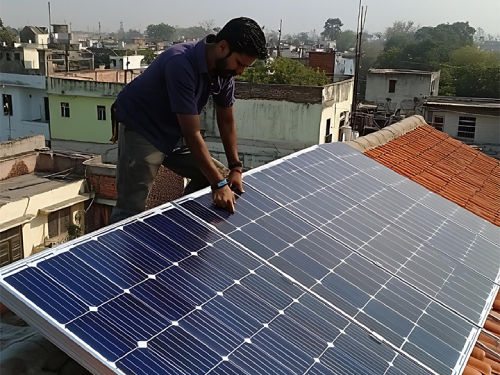
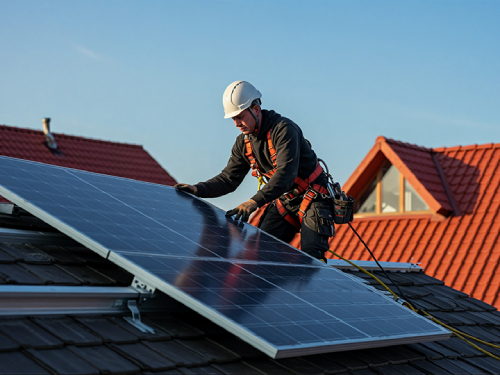
  • Step 1: Determine Energy Needs: Check your monthly electricity bills to understand how much power your home uses. This helps in choosing the right system size.

  • Step 2: Choose the Panel Type: Common options include monocrystalline, polycrystalline, and thin-film panels. The choice depends on efficiency, space, and budget.
  • Step 3: Check for Subsidy Eligibility: Many governments offer subsidies for residential solar. Subsidies can reduce the initial installation cost, so check local rules and programs.
  • Step 4: Select the Installation Location: Pick a spot with maximum sunlight and minimal shading. Roofs are ideal, but ground mounts can be used if roofing is unsuitable.
  • Step 5: Hire Professional Installers: Certified and experienced professionals ensure proper installation. Always compare warranties, pricing, and customer reviews.
  • Step 6: Choose On-Grid or Off-Grid: On-grid systems connect to the electricity grid and support net metering. Off-grid systems use batteries and operate independently.

  • Step 7: Install Mounting Structure: A mounting structure holds the panels at the right tilt and direction to maximize sunlight exposure.
  • Step 8: Install the Panels: Panels are fixed securely to the structure with proper alignment for efficient performance.
  • Step 9: Wiring and Inverter Setup: Panels are wired to the inverter, and batteries are added if required. The inverter converts solar DC power into usable AC power for the home.
  • Step 10: Testing and Inspection: Installers test the entire system to ensure safety and performance. Grid-connected systems may go through local authority approvals.
  • Step 11: Monitoring and Maintenance: Cleaning, basic inspections, and regular monitoring help maintain efficiency. With proper care, solar panels can last 20–25 years.

Cost of Solar Panel for Home Installation in India

Home solar install costs also vary based on factors such as system size, solar panels, inverter models, and installation needs. Even though investing in home solar or solar panels can be expensive, it is highly cost-effective over the long term, given the reduced cost of electricity bills. Solar loans or EMI facilities from banks/NBFCs can also be availed for assistance with initial costs.

Other financing options such as leasing enable consumers to harness solar energy without requiring funding to cover the entire cost of purchase. Government tax incentives also contribute to a reduction in the cost of solar installations in a residential setting. Homeowners can benefit from subsidies offered through programs initiated by the Ministry of New and Renewable Energy to reduce the cost of small solar systems installed in houses.

Things to Check Before Home Solar Installation

Before installing solar panels at home, here are a few important factors to review in order to ensure good performance and long-term benefits.

  • Location of residence and sunlight: Solar panels perform better where the sunlight is good. The quantum of sunlight your area receives decides the generation, hence probably the size of the system you decide on.

  •  Roof Orientation & Shading: Check the condition of the roof, its direction, and shading by trees or other buildings. Generally, south-facing roofs get the best sunlight. Ensure there is enough free space clear of obstruction for the number of panels required.

  • Electricity Needs of Your Household: Your consumption of electricity every month helps in the determination of the solar system size required. The appropriate estimate of energy requirements, along with probable savings, would be worked out in a detailed manner by studying the electricity bills and daily consumption patterns.

  •  Battery Requirement: The battery requirements are that the battery must have the ability to store surplus amounts of energy received from the sun. The sources of power that the battery store include power cuts and the evening.

  •  Long-Term Benefits and Savings: Invest in solar energy, which is a long-term investment with minimal maintenance costs. Solar panels are effective for 20-25 years, which means energy bills are also saved in the long term.

Maintenance and Life of Home Solar Panels

Home solar panels need a simple upkeep process if they are to continue working properly. Cleaning the solar cells will prevent dust and dirt from building up and thereby affecting the energy the panel generates. The electrical connections of the solar panel will be checked to ensure the safety and functionality of the solar panel. Homeowners will also be able to monitor the functionality of the energy produced from the solar panel. Annual home solar panel repair and upkeep will be recommended. Home solar panels will last for a period of 20 to 25 years.

Why Choose Alpex Solar for Home Solar Panels

Alpex Solar is one of the best providers of home solar solutions because it offers high-quality home solar panels, reliable home solar panel installation support, and home solar panels that perform efficiently at an affordable price. Homeowners get the benefit of long-lasting home solar panels suitable for Indian climatic conditions, high home solar panel efficiency, and home solar panel post-installation services. Alpex even offers support regarding subsidies, loans, and home solar panel size.

FREE SOLAR EXPERT CONSULTATION

Conclusion

A rooftop solar power system is an intelligent and progressive investment for Indian homes to lower electricity costs, achieve autonomy, and promote eco-friendlier power. Advances in technology, added government support, and enhanced borrowing options have led to a sharp decrease in the cost of home solar power investments. Choosing a trustworthy partner like Alpex Solar for quality offerings, assistance, and reliable back-up for a rooftop solar power system installation, Indian consumers can experience advanced functionality as well as a system that can last for a life span extending over decades. Solar power adoption can result in a positive impact on the home as well as a brighter future for the whole country.


Author : Gaurav Bector

Gaurav Bector, Vice President of the EPC division at Alpex Solar, is an Electrical Engineer with 32+ years of experience in the energy sector. He has led business development in smart energy systems, grid automation, and green solutions with top firms like ABB, Siemens, and Alstom. With global expertise across Europe, South Asia, and the Middle East, Gaurav excels in leadership, operations, sales, engineering, and project management.