
Key Takeaways

  • Explains the key differences between on-grid, off-grid, and hybrid solar systems for homes and businesses.

  • Highlights the advantages, limitations, costs, and ideal use cases of each solar system type.

  • Discusses important components like solar panels, inverters, battery storage, and monitoring systems.

  • Covers ROI, government subsidies, net metering benefits, and long-term cost savings of solar installations.

  • Provides guidance on choosing the right solar system based on budget, location, energy usage, and backup requirements.

  • Explores future solar trends, including smart hybrid systems, AI-based energy management, and battery innovations.

Difference Between On-Grid, Off-Grid, and Hybrid Solar Systems: Complete Guide for Homes & Businesses

Introduction to Solar Power Systems

With rising electricity costs and growing awareness of clean energy, solar power has become one of the most preferred energy solutions for homes and businesses in India, offering long-term financial and environmental benefits by reducing monthly electricity bills and supporting sustainability goals.

 Today, homeowners, industries, commercial establishments, and institutions are increasingly switching to solar systems to achieve energy independence and better power efficiency, supported by government incentives and advancements in solar technology that make installations more accessible than ever.

 However, before investing in solar energy, it is important to understand the different types of solar systems available in the market, as the right choice directly impacts energy savings, backup capability, and overall return on investment (ROI)

The three major types of solar systems are:

  • On-grid solar systems
  • Off-grid solar systems
  • Hybrid solar systems

Each system is designed for different energy needs, locations, and usage patterns. Whether you want to lower your electricity bills, achieve complete energy independence, or ensure uninterrupted power during outages, selecting the right solar solution is essential.

Brands like Alpex Solar are helping residential and commercial users adopt reliable and efficient solar technologies tailored to diverse energy requirements.

In this complete guide, we will explain the difference between on-grid, off-grid, and hybrid solar systems, along with their working principles, advantages, disadvantages, and ideal applications for homes and businesses.

What Is an On-Grid Solar System?

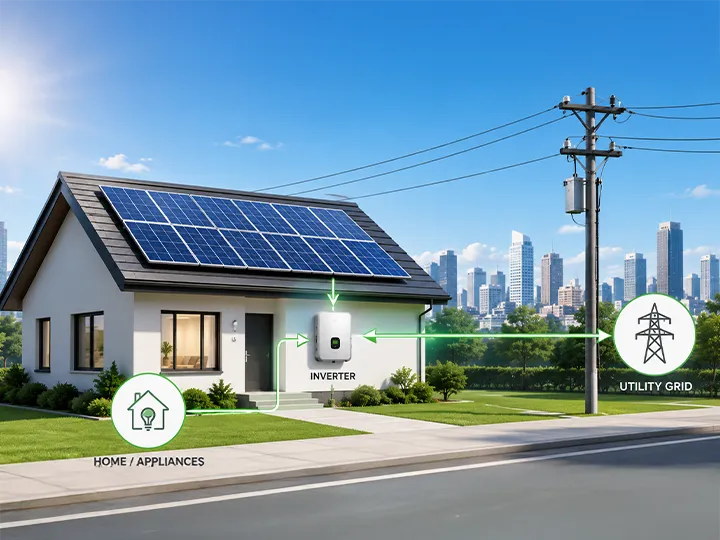
An on-grid solar system is a solar power setup that is directly connected to the local electricity grid. It allows homes and businesses to generate electricity using solar panels while still having access to grid power when needed. This type of system is widely used because it helps reduce electricity bills without requiring battery storage. During the day, solar panels produce electricity that powers appliances and other electrical systems within the property.
How On-Grid Solar System Works
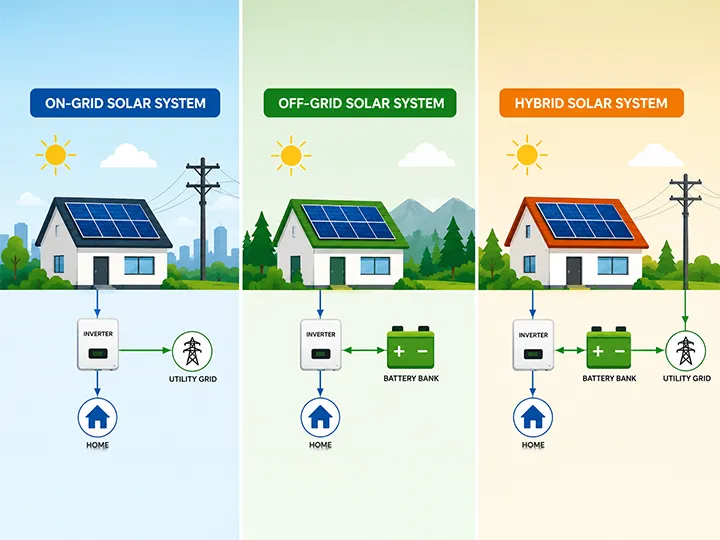
An on-grid solar system is connected to the utility grid through a solar inverter, which converts DC electricity from solar panels into AC power for use. The system first uses solar energy to meet demand and draws from the grid when needed. Through net metering, excess solar power is exported to the grid for credits, while electricity is imported during low generation periods like night or cloudy weather, ensuring a continuous and reliable power supply.

Advantages of On-Grid Solar Systems
On-grid solar systems offer several key advantages that make them a popular choice for residential and commercial users. Lower installation cost is a major benefit, as these systems do not require expensive battery storage, reducing overall setup and maintenance expenses. Net metering benefits allow users to earn credits by exporting excess solar energy to the grid, significantly lowering electricity bills. Additionally, government subsidies and incentives further reduce the upfront investment, making solar adoption more affordable and attractive.

Limitations of On-Grid Systems
The main limitation of an on-grid solar system is no backup during power outages. Since these systems are directly connected to the utility grid, they automatically shut down during a grid failure for safety reasons. This means solar power cannot be used during blackouts unless a battery backup or hybrid system is installed.

What Is an Off-Grid Solar System?

An off-grid solar system is a standalone power setup that operates independently of the utility grid. It generates electricity from solar energy and stores it in batteries for later use, ensuring power availability even in remote areas or during grid unavailability.

How Off-Grid Solar Systems Work

An off-grid solar system works through a combination of Solar Panels, Battery Storage, Charge Controller, and Inverter. The Solar Panels generate DC electricity from sunlight, which is regulated by the Charge Controller to prevent battery overcharging. The energy is stored in Battery Storage for later use, and the Inverter converts it into usable AC power for running electrical appliances.

Benefits of Off-Grid Solar Systems

Off-grid systems provide Energy Independence, allowing users to generate and use their own electricity without relying on the utility grid. They are also Ideal for Remote Locations where grid access is unavailable or unreliable.

Drawbacks of Off-Grid Systems

The main drawback of off-grid systems is the higher cost due to batteries, as energy storage significantly increases the initial investment. Additionally, battery maintenance is required over time to ensure consistent performance and system reliability.

What Is a Hybrid Solar System?

A hybrid solar system combines grid connection and battery storage in one setup. It generates power from solar panels, stores excess energy in batteries, and uses the grid as backup when needed. The system automatically switches between solar, battery, and grid power, ensuring a continuous electricity supply even during power cuts or low sunlight conditions.

How Hybrid Solar Systems Work

A hybrid solar system combines grid connection + battery storage, allowing users to generate solar power, store excess energy in batteries, and also remain connected to the utility grid for backup and flexibility.

Components of Hybrid Solar Systems

A hybrid system consists of Solar Panels for energy generation, a Hybrid Inverter for smart power management, a Battery Bank for energy storage, and the Utility Grid for backup and additional supply when needed. This system includes solar panels for energy generation, a hybrid inverter with built-in MPPT and battery management, a battery bank (lithium-ion or lead-acid) for storage, and the utility grid for backup power when required.

Benefits of Hybrid Solar Systems

Hybrid systems offer backup during outages, ensuring uninterrupted power supply even when the grid fails. They also provide energy optimization by efficiently managing solar, battery, and grid power to reduce electricity costs. It reduces dependence on the grid electricity and provide reliable backup during outages. They also improve energy efficiency by maximizing solar usage and help reduce electricity costs during peak tariff periods.

Limitations of Hybrid Solar Systems

The main limitation of hybrid solar systems is the higher upfront cost, due to the inclusion of batteries and advanced inverter technology. These also require battery maintenance and replacement over time, and system performance depends on proper battery sizing and configuration.

Difference Between On-Grid, Off-Grid, and Hybrid Solar Systems

FeatureOn-GridOff-GridHybrid
Grid ConnectionYesNoYes
Battery StorageNoYesYes
Power During OutageNoYesYes
CostLowHighMedium–High
Best ForCitiesRemote AreasMixed Usage

On-Grid vs Off-Grid vs Hybrid Solar System Cost Comparison

Solar system costs vary significantly based on system type, battery inclusion, and installation quality. In general, on-grid systems are the most affordable, off-grid systems are the most expensive due to batteries, and hybrid systems fall in between but offer higher flexibility and backup benefits. Industry benchmarks from residential and commercial solar markets show that pricing also varies across India and global regions due to subsidies, equipment quality, and net metering policies.

Average Solar System Cost (India / Global)

Solar installation costs are usually calculated per kilowatt (kW), and they increase with system complexity—especially when battery storage is included.

For India (typical residential rooftop systems):

1. 1kW system

On-grid: ₹55,000 – ₹85,000
Hybrid: ₹1,00,000 – ₹1,30,000
Off-grid: ₹85,000 – ₹1,10,000

2. 3kW system

On-grid: ₹1,60,000 – ₹2,25,000
Hybrid: ₹2,70,000 (typical)
Off-grid: ₹2,40,000 (typical)

3. 5kW system

On-grid: ₹2,75,000 – ₹3,75,000
Hybrid: ₹4,00,000 – ₹6,00,000+
Off-grid: ₹5,00,000 – ₹8,00,000+

For global markets (approximate USD range):

On-grid: $700 – $1,300 per kW
Hybrid: $1,300 – $2,200 per kW
Off-grid: $1,800 – $3,000+ per kW

The major cost driver in off-grid and hybrid systems is the battery bank, which can account for 30–50% of total system cost.

ROI and Payback Period

The return on investment (ROI) depends on electricity savings, system size, and local tariff rates.

  • On-grid systems offer the fastest payback, typically 3–6 years, due to net metering benefits and low maintenance costs.
  • Hybrid systems have a slightly longer payback of 5–8 years, but provide added value through backup power and energy optimization.
  • Off-grid systems have the longest payback period, often 7–12 years, as they are primarily designed for energy independence rather than cost savings.

Higher electricity tariffs and better sunlight exposure can significantly improve ROI across all system types.

Government Subsidies and Net Metering

Government support significantly reduces solar adoption costs, especially for on-grid rooftop systems in India. Residential users can receive central and state subsidies under rooftop solar programs, reducing upfront costs by 20%–40% depending on system size and state policy. Net metering further improves financial benefits by allowing users to export excess solar power to the grid and earn electricity credits, which lowers bills and shortens the payback period. Off-grid systems are generally not eligible for subsidies or net metering as they operate independently, while hybrid systems may qualify partially based on state rules and grid connectivity. Companies like Alpex Solar support this ecosystem by supplying efficient solar modules that enhance energy generation, improve ROI, and reduce payback time for residential and commercial systems.

How to Choose the Right Solar System

Choosing the right solar system depends on factors like grid reliability, budget, electricity usage pattern, and need for backup power. Industry comparisons of on-grid vs off-grid solar systems show that there is no single “best” option—it completely depends on location and energy requirements.

Choose On-Grid If

An on-grid solar system is ideal if you have a stable electricity supply and want to focus on maximum bill savings through net metering. It is best suited for urban and semi-urban areas, where grid availability is reliable and power cuts are minimal. On-grid systems also offer the advantage of lower installation cost and faster ROI, making them the most commonly installed solar solution in India.

Choose Off-Grid If

An off-grid solar system is recommended for remote locations with no access to the utility grid. It is commonly used in rural homes, farms, telecom sites, and isolated facilities, where complete energy independence is required. These systems rely heavily on battery storage and charge controllers, making them more expensive but fully self-sufficient. They are also suitable in areas where grid reliability is extremely poor or unavailable.

Choose Hybrid If

A hybrid solar system is the best choice if you experience frequent power outages but still want the benefits of net metering and electricity savings. It combines solar panels, battery storage, and grid connectivity, allowing users to store excess energy and also export it when possible. Hybrid systems are increasingly preferred for homes and small businesses needing both backup power and energy optimization, making them the most flexible option among the three

Solar System Use Cases

Solar energy is widely adopted across residential, commercial, and industrial,  segments due to its ability to reduce electricity costs, improve energy reliability, and support sustainability goals. Modern solar solutions are designed to scale based on consumption patterns and operational needs, making them suitable for almost every sector.

Residential Solar Systems

Residential solar systems are commonly used in homes and apartments to reduce monthly electricity bills and increase energy independence. Homeowners typically prefer on-grid systems for net metering benefits, while some opt for hybrid systems in areas with frequent power cuts. In apartments and housing societies, rooftop solar installations are increasingly being adopted for common area power supply, lifts, and lighting loads, helping reduce shared electricity expenses.

These systems are especially beneficial in urban areas where electricity tariffs are higher and rooftop space is efficiently utilized.

Commercial Solar Systems

Commercial solar systems are widely used in offices, retail stores, and hospitals, where electricity consumption is continuous during working hours. These setups help businesses significantly reduce operational costs and improve long-term profitability.

Offices benefit from daytime solar generation that aligns with peak working hours, while retail stores use solar power to reduce high utility expenses in commercial tariff zones. Hospitals, which require uninterrupted power supply, often combine solar with backup solutions like hybrid systems to ensure reliability for critical equipment.

Solar solutions from manufacturers like Alpex Solar help commercial users achieve higher efficiency with durable, high-performance modules suitable for large-scale rooftops.

Industrial Solar Systems

Industrial solar systems are designed for manufacturing units and warehouses with high energy demand and long operating hours. Industries install large-scale rooftop or ground-mounted solar plants to reduce electricity use from machinery and production processes. Warehouses benefit through lower lighting and ventilation costs, while manufacturing units reduce per-unit production costs and improve sustainability ratings. Many industries use on-grid or hybrid systems with net metering or captive consumption models to maximize financial returns and energy efficiency. Companies like Alpex Solar provide scalable solar solutions and advanced modules that support long-term energy savings and operational efficiency for industrial and commercial users.

Key Components Used in Solar Power Systems

A solar power system is made up of several critical components that work together to generate, convert, store, and manage electricity efficiently. Each component plays a specific role in ensuring optimal performance, safety, and long-term reliability of the system.

Solar Panels

Solar panels are the primary energy-generating component of a solar system. They convert sunlight into direct current (DC) electricity using photovoltaic (PV) cells. Modern panels are available in technologies like monocrystalline and bifacial modules, which offer higher efficiency and better performance in low-light conditions. High-quality modules, such as those supplied by manufacturers like Alpex Solar, help improve energy yield and system lifespan.

Solar Inverter

The solar inverter converts DC electricity from solar panels into alternating current (AC), which is used by household and industrial appliances. It also ensures grid synchronization, voltage regulation, and safety protection. Advanced inverters, such as string inverters, microinverters, and hybrid inverters, improve system efficiency and allow better energy management across different load conditions.

Battery Storage

Battery storage systems store excess solar energy for later use, especially during nighttime or power outages. Common technologies include lithium-ion and lead-acid batteries, with lithium-ion being preferred due to higher efficiency, longer lifespan, and faster charging. Batteries are essential in off-grid and hybrid solar systems for ensuring energy independence and backup power.

Mounting Structures

Mounting structures provide mechanical support to solar panels and ensure proper alignment for maximum sunlight exposure. They are designed to withstand environmental conditions such as wind load, rain, and corrosion. Common types include rooftop mounts, ground-mounted structures, and tilt-adjustable systems, which help optimize solar performance based on location.

Monitoring System

A solar monitoring system tracks real-time performance of the entire installation. It provides data on energy generation, consumption, system efficiency, and fault detection. Modern monitoring tools are often app-based or cloud-connected, allowing users and operators to analyze performance remotely and ensure maximum system efficiency.

Common Mistakes When Choosing a Solar System

Choosing a solar system requires careful planning, but many users make avoidable mistakes that can reduce efficiency, increase costs, or limit long-term benefits. Industry installation data shows that most issues arise not from technology, but from poor system planning and incorrect assumptions about energy needs.

Ignoring Backup Requirements

One of the most common mistakes is ignoring backup power needs. Many users install on-grid systems without considering power outages, which leads to inconvenience during grid failures since these systems shut down for safety reasons. In regions with unstable electricity supply, failing to plan for battery backup or hybrid systems can significantly reduce system usefulness.

Choosing Wrong System Size

Another major error is selecting an incorrect system size without analyzing actual energy consumption. Undersized systems fail to meet electricity demand, while oversized systems increase unnecessary upfront cost. Proper sizing should be based on daily load calculation (kWh usage), roof space availability, and future energy expansion plans. Industry experts recommend conducting an energy audit before installation to avoid mismatch between generation and consumption.

Not Considering ROI

Many users focus only on installation cost and ignore return on investment (ROI) and payback period. However, solar systems are long-term investments, and factors like electricity tariff rates, net metering benefits, and system efficiency heavily influence financial returns. Ignoring ROI can lead to selecting systems that are cheaper initially but less beneficial over time. On-grid systems generally offer the fastest payback, while off-grid systems prioritize independence over financial return.

Additional Common Mistakes (Industry Insights)

Beyond the basic errors, there are several other overlooked issues:

  • Ignoring component quality: Low-quality panels or inverters reduce system lifespan and efficiency.

  • Poor installer selection: Uncertified or inexperienced installers can lead to design and wiring issues.
  • Neglecting maintenance planning: Dust accumulation and lack of periodic cleaning reduce energy generation.
  • Not checking government policies: Missing out on subsidies and net metering approvals can increase overall cost.


Alpex Solar emphasize high-quality components and reliable system design, helping users avoid common installation and performance-related mistakes.
Check out the Solar Panel Guide from Alpex Solar to understand which system size is right for your home

Future Trends in Solar Energy Systems

The solar energy industry is evolving rapidly, driven by advances in digital technology, energy storage, and system efficiency. Future solar systems are expected to be smarter, more automated, and more integrated with both homes and the utility grid, making solar power even more reliable and cost-effective.


Smart Hybrid Solar Systems

Smart hybrid solar systems represent the next stage of solar evolution, combining solar panels, battery storage, and grid connectivity with intelligent power management. These systems automatically decide when to use solar energy, when to store excess power, and when to draw from the grid, based on real-time demand and electricity pricing. This helps users maximize savings while ensuring uninterrupted power supply, especially in areas with unstable grids or peak tariff variations.

AI-Based Energy Management

The integration of AI (Artificial Intelligence) in solar energy systems is becoming a major trend. AI-based systems analyze energy consumption patterns, weather forecasts, and grid demand to optimize power usage. For example, they can predict high-generation solar hours and prioritize battery charging or load shifting accordingly. This leads to improved energy efficiency, reduced wastage, and better cost optimization for both residential and commercial users. Smart monitoring platforms are increasingly using machine learning to detect faults early and improve system performance over time.

Battery Innovation

Battery technology advancements are driving future solar adoption, with the industry shifting from lead-acid batteries to lithium-ion and emerging solid-state batteries, offering higher efficiency, longer lifespan, and faster charging. Future systems are expected to be more compact, safer, and affordable, making energy storage more accessible. Innovations like modular battery packs and second-life EV batteries will further reduce costs and support large-scale renewable energy use. Improved storage will make hybrid and off-grid systems more practical and reliable even in high-demand conditions. Companies like Alpex Solar support this transition with high-efficiency solar modules that integrate with next-generation smart and hybrid energy systems, enabling smarter and more sustainable power solutions.

FREE SOLAR EXPERT CONSULTATION

FAQs 

An on-grid system is connected to the utility grid and does not use batteries, while an off-grid system works independently with battery storage. A hybrid system combines both, using solar, batteries, and grid power for maximum flexibility and backup.

For most homes, an on-grid solar system is best due to lower cost and net metering benefits. However, in areas with frequent power cuts, a hybrid system is more suitable.

Only off-grid and hybrid solar systems work during power cuts because they use battery storage. On-grid systems shut down for safety when the grid is unavailable.

In India, an on-grid solar system typically costs around ₹55,000 to ₹80,000 per kW, depending on quality, brand, and installation type. Subsidies can further reduce the overall cost.

Yes, an on-grid system can be upgraded to a hybrid system by adding a battery bank and hybrid inverter, but compatibility of existing components must be checked.

No, batteries are not required in on-grid systems. They directly supply power to the home and grid without storage.

Most lithium-ion batteries last 8–12 years, while lead-acid batteries last around 3–5 years, depending on usage, temperature, and maintenance.

Author : Gaurav Bector

Gaurav Bector, Vice President of the EPC division at Alpex Solar, is an Electrical Engineer with 32+ years of experience in the energy sector. He has led business development in smart energy systems, grid automation, and green solutions with top firms like ABB, Siemens, and Alstom. With global expertise across Europe, South Asia, and the Middle East, Gaurav excels in leadership, operations, sales, engineering, and project management.