

Key Summary
Rising electricity prices, increasing demand for energy, and a strong push for sustainable solutions have made solar energy one of the best long-term sustainable energy sources available in India today. One of the best investments businesses, industries, and institutional investors can make is a 1 MW Solar Plant. Not only do they save businesses, industries, and institutional investors considerable money, but they also generate clean energy, providing a tremendous opportunity for businesses and organizations to contribute toward India’s renewable energy and Carbon Reduction goals.
What is a 1 MW solar power plant in India, and who should invest
The 1 MW solar generation facility, frequently deployed in industrial and commercial applications of renewable energy through the use of Photovoltaic (PV) panels to generate electricity from the Sun, produces renewable electricity from a combination of solar energy and conventional energy. The footprint of a typical 1 MW solar power generation facility consists of about 4–5 acres and has the capability of producing up to 4,000 kWh of electricity each day, which is sufficient to meet a majority of the energy needs of high-demand users while at the same time decreasing their dependence on traditional grid-based kraft electricity generation facilities.
A 1 MW solar power plant is best suited for individuals and organizations looking for long-term, stable, and sustainable returns. Ideal investors include:
The 1 MW solar generation facility, frequently deployed in industrial and commercial applications of renewable energy through the use of Photovoltaic (PV) panels to generate electricity from the Sun, produces renewable electricity from a combination of solar energy and conventional energy. The footprint of a typical 1 MW solar power generation facility consists of about 4–5 acres and has the capability of producing up to 4,000 kWh of electricity each day, which is sufficient to meet a majority of the energy needs of high-demand users while at the same time decreasing their dependence on traditional grid-based kraft electricity generation facilities.
A 1 MW solar power plant is best suited for individuals and organizations looking for long-term, stable, and sustainable returns. Ideal investors include:
In short, a 1 MW solar plant is ideal for investors who have a long-term vision, access to land or capital, and a need for reliable, cost-effective, and clean power.


What is the cost of a 1 MW solar power plant in India for a large project?
The cost of setting up a 1 MW solar power plant in India generally falls between ₹4 crore and ₹6 crore, depending on factors such as location, technology, equipment quality, and project execution. Below is an indicative cost breakup to help understand the investment structure:
Estimated Cost Breakdown:
| Component | Approximate Cost (₹) |
|---|---|
| Solar panels | 3 crore |
| Solar inverters | 1 crore |
| Combiner & junction boxes | 20 Lakh |
| Protective equipment | 10 lakh |
| SCADA system & data logger | 7 lakh |
| Land (4–5 acres) | Varies by location |
| Erection & installation | 50 lakh |
| Total estimated project cost | ₹4.8–₹5 crore |
Technical Specifications
These specifications make a 1 MW solar plant a reliable option for large scale power plant applications, delivering predictable energy output and long-term cost savings when designed, installed, and maintained properly.
Which factors affect the cost of a 1 MW solar power plant in India
Several technical and site-specific factors directly impact the overall cost of a 1 MW solar power plant. Understanding these helps in better project planning and cost optimization:

How much land is required for a 1 MW solar power plant in India
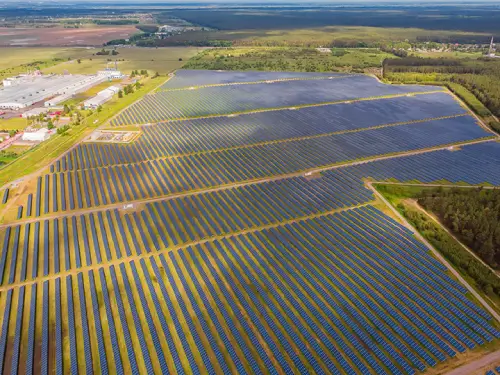
A 1 MW solar power plant in India typically requires around 4–5 acres of land. The exact land requirement depends on several factors, such as the type of solar panels used, their efficiency, tilt angle, row spacing, and the overall plant layout.
Higher-efficiency panels can slightly reduce land usage, while tracking systems or lower-efficiency modules may require additional space. Beyond size, the location and availability of land play a crucial role in overall project cost. Land closer to grid infrastructure and with minimal leveling needs helps lower civil and evacuation expenses, improving the project’s financial viability.
What is the grid connection and approval cost for a 1 MW solar plant?
When setting up a 1 MW solar power plant in India, grid connection and regulatory approvals are important cost components that must be planned for before commissioning. These costs can vary widely based on how far the plant site is from the nearest substation, the voltage level of connection, and the local utility/discom policies.
Substation and Transmission Cost
To evacuate power from your solar plant to the grid, the project usually needs to build a transmission line and bay extension up to the nearest substation. If the substation is several kilometres away, the cabling, protection systems, and bay connection costs can range from roughly ₹30 lakh to ₹70 lakh or more for a 1 MW plant. Long-distance lines and additional switches or transformers increase this expense.
Grid Connectivity Charges
Connecting the solar plant to the local grid requires coordination with the state transmission utility (STU) or central transmission utility (CTU) and the local DISCOM. Charges typically include:
- Bay charges at the receiving substation
- System strengthening or network upgrade fees
- Protection, metering, and synchronization costs
These charges vary state by state and are often determined by the regulator (SERC) and local utility policies. They become part of the grid-connection agreement and must be settled before synchronization.
Approval and Permit Expenses
Before commissioning, several regulatory permissions and technical clearances are required:
- Connection agreement with the DISCOM
- CEIG (Chief Electrical Inspector to Government) inspection
- Technical feasibility and grid impact assessments
- Open access or wheeling approvals (if selling power outside the DISCOM area)
Approval processes can incur fees and require submission of detailed documentation. Delays in approval also add indirect costs through project timeline extensions. These permitting costs can vary significantly and should be estimated early in project planning.
Is there any government subsidy for a 1 MW solar power plant in India
There is no direct subsidy provided by the government to establish a 1 MW solar power plant. But there exist certain indirect benefits provided by the Indian Government to initiate a solar power plant. A 40% depreciation benefit is provided to industrial consumers on their assets within the first year of the establishment of a solar power plant.
The owners of a 1 MW solar power plant can make use of net metering facilities in most states of India. This allows customers to sell their surplus electricity back to the grid and get paid for it.
How much power does a 1 MW solar plant generate in India?
A 1 MW (megawatt) solar power plant generates electricity in kilowatt-hours (kWh). The actual output depends on solar irradiance, location, weather conditions, system efficiency, orientation, and overall losses.
Basic Calculation Method
- Installed capacity: 1 MW = 1,000 kW
- Energy generation (kWh) = Capacity (kW) × Peak sun hours × Performance factor
- Typical performance factor: 0.75–0.90 (commonly 0.80, accounting for inverter, temperature, dust, wiring, and shading losses)
Typical performance factor: 0.75 to 0.90 (typically 0.80 for losses due to the inverter, temperatures, dust
Average Peak Sun Hours in India
- High irradiance regions (Rajasthan, Gujarat):
- Good solar zones (Maharashtra, Telangana, MP): 4
- Moderate Sun areas: between 3.5 and
Calculating Estimated Power Generation
- Daily generation: 4,000 to 4,800
- Average Monthly Production: 1.2-1.4 lakh kWh
- Generation per year: 14.4 to 17.3 units (lakh units
These data render the 1 MW solar energy plant a feasible choice for bulk electricity production in India, particularly in areas with high solar intensity.
What is the ROI and payback period for a 1 MW solar power plant?
An investment in a 1 MW solar power plant offers strong financial returns, making it a highly viable option for businesses and large power consumers.
| Financial Aspect | Details |
|---|---|
| Initial investment | ₹3.5 crore – ₹6 crore |
| Annual savings / revenue | ₹40 lakh – ₹70 lakh |
| Payback period | 5–8 years |
| Expected ROI | 12–15% per year |
With predictable energy generation, low operating costs, and long-term asset life, a 1 MW solar plant provides consistent returns while helping enterprises reduce energy expenses and carbon footprint.
What is the installation timeline for a 1 MW solar power plant in India
The actual installation of a 1 MW solar power plant in India will require a period of 120 to 180 days. This will be approximately 4-6 months. The duration may also differ based on a variety of factors. The phase-wise breakup of a life span of 4-6 months will be:
Is a 1 MW solar power plant a good investment in India
Yes, 1 MW solar power plant is generally regarded as a profitable investment opportunity for India. It presents a remarkable payback period of 3-6 years, long-term power autonomy, and major green benefits. Since it requires a fund outlay of around ₹4-6 crores, major power consumers like manufacturing units, hospitals, and business centers can derive considerable economic benefits by mitigating high rates of grid power consumption, which usually vary between ₹8-12 per unit. However, apart from these economic advantages, it develops long-term economic management benefits.

FREE SOLAR EXPERT CONSULTATION
Conclusion
Investing in a 1 mw Solar Power Plant in India makes sense from all perspectives, including financially and environmentally. A 1 MW Plant has predictable generation characteristics, indirect Government incentives, and a lifespan of 25+ years, which means it should provide a long-term return on investment. In addition, high-energy users, who will see a continuing increase in grid prices in the coming years, will receive additional benefits from their solar project because they will no longer have to pay those high grid prices. With proper planning, utilizing the proper technology and getting expert assistance from Alpex Solar; a 1 MW Solar Power Plant can become more than just a source of power, it can develop into an asset that will be there for the long run, supporting the growth of businesses while meeting the expectations and requirements of companies who have pledged to be responsible to the environment.