Key Summary
The solar industry is rapidly evolving, making the comparison between TOPCon vs Mono PERC solar panels more important than ever in 2026. While mono PERC solar panels have long been the industry standard due to their cost-effectiveness and reliability, TOPCon solar cell technology is emerging as a high-efficiency alternative with better long-term performance.
In India, this shift is driven by the need for higher energy output, improved durability, and better returns from rooftop solar panels and large-scale projects. Choosing the right technology today is not just about upfront cost, but about efficiency, degradation, and overall return on investment over time.
Executive Summary for Commercial Solar Buyers
In 2026, choosing either Mono PERC or TOPCon solar cells as an EPC contractor, developer, or commercial buyer will be a crucial decision that can significantly affect the overall return on investment, efficiency, and energy output from solar technology. Although Mono PERC solar cells offer a relatively inexpensive and readily available alternative, TOPCon solar cells have been gaining prominence as the preferred option.
| Parameter | Mono PERC Solar Panels | TOPCon Solar Panels |
|---|---|---|
| Technology Type | Passivated Emitter and Rear Cell (PERC) | Tunnel Oxide Passivated Contact (TOPCon) |
| Efficiency | 19–21% | 22–23%+ |
| Year-1 Degradation | ~2% | ~1% |
| 25-Year Performance | ~80–82% output retention | ~87–89% output retention |
| Temperature Performance | Moderate | Superior (better in high heat) |
| Low-Light Performance | Good | Excellent |
| Bifacial Capability | Limited | Strong (commonly bifacial) |
| Cost per Watt | Lower | Slightly higher (gap narrowing) |
| Best Use Case | Budget-driven projects | Performance-driven, long-term ROI projects |

Understanding the Core Technologies
What Is a TOPCon Solar Panel?
TOPCon, or Tunnel Oxide Passivated Contact, refers to the new generation of solar cells that aim to increase efficiency and decrease energy loss. TOPCon technology integrates an extremely thin oxide layer and a silicon layer with dopants into the existing solar cell structure to improve electron transport and reduce recombination.
What Is a Mono PERC Solar Panel?
Mono PERC Solar Panels represent a sophisticated form of the conventional mono-crystalline solar panels. The inclusion of a passivation layer at the back of the cell enhances light absorption and reduces energy loss, rendering the panel more efficient than ordinary solar cells.
While both technologies enhance energy efficiency, Mono PERC emphasizes efficiency at a lower cost, while TOPCon maximizes efficiency, longevity, and energy output, earning preference among modern solar technologies.
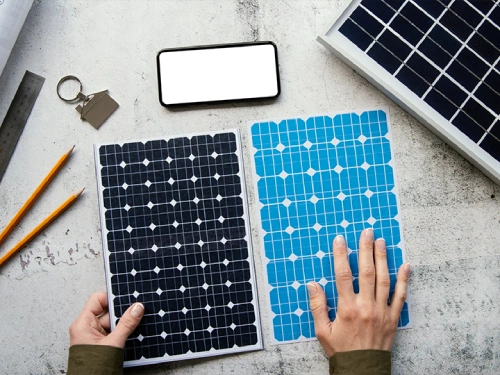
TOPCon vs Mono PERC: Technical Comparison (2026 Benchmarks)
This section focuses on the key technical differences that matter for real-world performance in 2026, without repeating basic definitions. The comparison highlights how each technology performs under actual operating conditions.
Efficiency Range in 2026
| Metric | Mono PERC | TOPCon |
|---|---|---|
| Commercial Module Efficiency | 19–22% | 22–24% |
| Practical Output per m² | Lower | Higher |
TOPCon delivers higher power density, which directly improves output in space-constrained installations.
Degradation and Long-Term Output
| Metric | Mono PERC | TOPCon |
|---|---|---|
| Year 1 Loss | Higher | Lower |
| Annual Degradation | Higher | Lower |
| 25-Year Energy Yield | Standard | Higher cumulative output |
Lower degradation in TOPCon results in more total energy generation over the system lifetime, which is critical for ROI-focused projects.
Temperature Coefficient
| Metric | Mono PERC | TOPCon |
|---|---|---|
| Heat Sensitivity | Higher | Lower |
| Performance in Hot Climates | Moderate | Strong |
TOPCon maintains better efficiency in high-temperature environments, making it more suitable for regions with intense heat exposure.
Low-Light and Irradiance Performance
| Condition | Mono PERC | TOPCon |
|---|---|---|
| Early Morning / Evening | Good | Better |
| Cloudy Conditions | Stable | More efficient |
TOPCon ensures more consistent generation throughout the day, improving overall system yield.
Bifacial Gain Potential
| Metric | Mono PERC | TOPCon |
|---|---|---|
| Bifacial Compatibility | Limited | Strong |
| Rear-Side Energy Gain | Moderate | Higher |
TOPCon is better suited for bifacial applications, leading to higher total energy output, especially in reflective environments.
Technology Ceiling and Scalability
| Factor | Mono PERC | TOPCon |
|---|---|---|
| Efficiency Improvement Potential | Limited | Higher |
| Industry Adoption Trend | Stable | Rapidly growing |
Mono PERC is approaching its performance limits, while TOPCon still has room for efficiency improvements and wider adoption.
From a 2026 benchmark perspective, the difference is clear:
- Mono PERC remains a stable and cost-efficient option
- TOPCon delivers better performance across all critical technical parameters
For projects where long-term energy yield and efficiency are key decision factors, TOPCon holds a measurable technical advantage.
Cost & ROI Analysis for B2B Buyers
In the case of commercial customers, it is necessary to find a balance between the initial cost of the investment and the profitability of the system during its entire life cycle. Mono PERC solar panels have relatively low prices due to their long history and widespread use. However, the lower efficiency and higher degradation rate negatively affect the total energy output.
On the other hand, the price for TOPCon panels is slightly higher than that for Mono PERC modules. Nevertheless, with mass production, this price difference will eventually decrease. TOPCon panels produce more power than Mono PERC because of their high efficiency and stability, which increases the profit.
Bifacial solar panels offer an interesting opportunity for commercial companies because of their ability to collect energy not only from direct sunlight but also from indirect sources. As a result, in some cases, it becomes possible to create a second source of power output. For example, in India, a large country with vast territory, the energy generated by bifacial panels is significantly higher compared to conventional models. The increased energy output during 25–30 years often compensates for the higher initial cost.
Consequently, Mono PERC solar panels help minimize initial expenses, while TOPCon technology maximizes profits.
Application-Based Decision Guide
The decision between Mono PERC and TOPCon depends on the nature of the project, cost, and expected performances of the cells. As different parties have varied priorities, there would be a range of solutions that fit better in certain contexts.
Comparison Table: TOPCon vs Mono PERC (Quick Snapshot)
| Parameter | Mono PERC Solar Panels | TOPCon Solar Panels |
|---|---|---|
| Efficiency | 19–21% | 21–23%+ |
| Temperature Tolerance | Moderate | Better performance in high heat |
| Degradation Rate | Year 1: ~2% Then ~0.55%/year | Year 1: ~1% Then ~0.4%/year |
| Low-Light Performance | Good | Better than Mono PERC |
| Bifacial Capability | Limited | Strong (widely available) |
| Cost | Lower upfront cost | Slightly higher upfront cost |
| Warranty | ~25 years (performance) | ~30 years (performance) |
| Best For | Budget-conscious residential & small commercial projects | High-efficiency, long-term ROI, commercial & utility-scale projects |
Final Verdict: Which Technology Should Your Business Choose in 2026?
Whether to choose Mono PERC or TOPCon solar panels depends on your preference in terms of project needs, primarily whether you want a low cost approach or are interested in high performing and high energy producing panels.
Select Mono PERC solar panels when:
- You require reliable technology that has been tried and tested for years
- Your project demands a low budget option with lower upfront cost
- Availability of space does not play a significant role in your project
- Cost savings is important but without compromising on performance
Select TOPCon solar panels when:
- You prefer an efficient option that yields the highest power possible from minimum installation area
- You wish for long lasting performance with minimal power loss over time
- Operating environment is tough, for example, high temperatures or low sunlight conditions
- Upfront investment is acceptable with higher lifecycle benefits
- You are looking for future-proof technology
The mono PERC module is still reliable and cost-effective for several applications. Nevertheless, the TOPCon will prove to be the superior technology in the year 2026 because of its high efficiency levels, longevity, and enhanced environmental adaptability.
TOPCon will eventually be considered the superior solar technology as production scales up and pricing falls. This makes it a good option for companies that need large-scale applications and consider future energy requirements.
Alpex Solar and other solar companies have started embracing such technologies through offering advanced solar modules that cater to present and future project energy requirements.